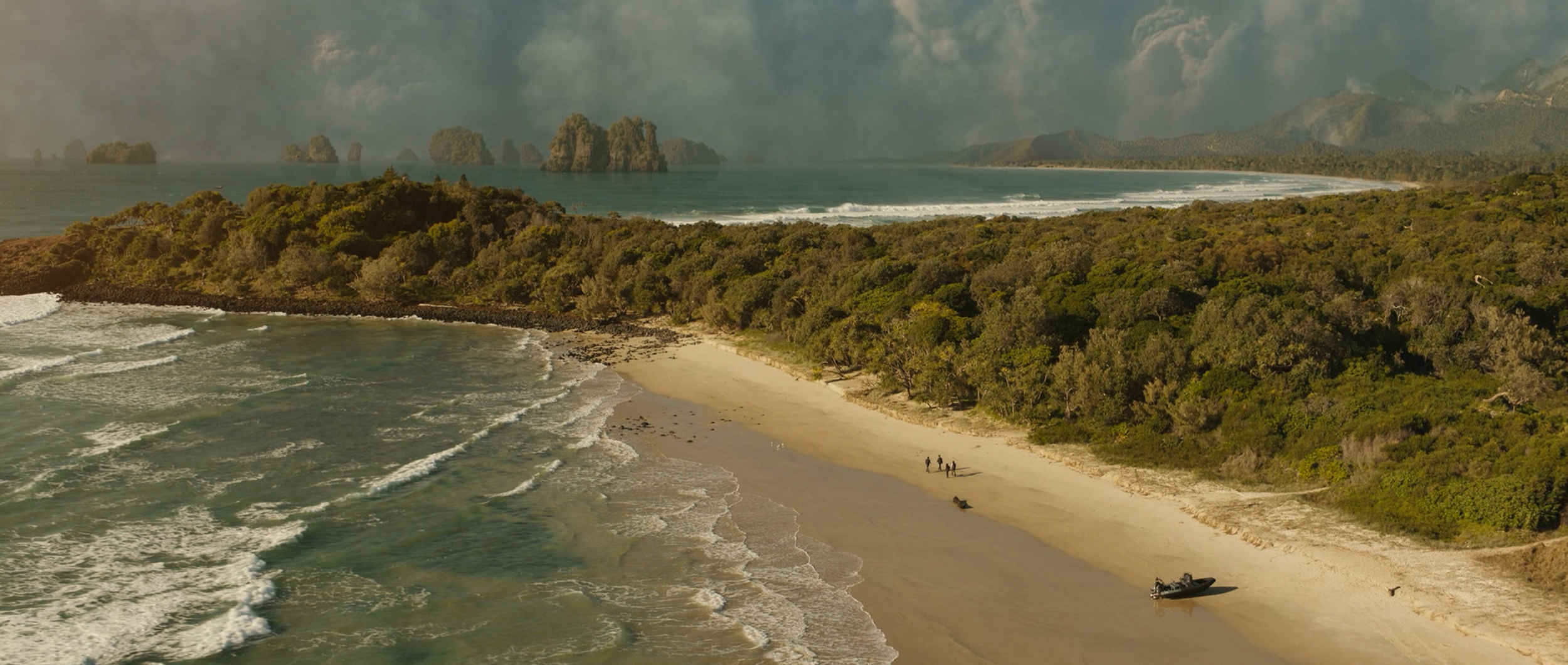
FIN delivered 122 VFX shots across ten episodes, with the bulk of the heavy lifting landing in just three key episodes. It pushed every department to evolve our pipeline, particularly around creature work and large-scale environment simulations, and became one of the most ambitious projects we’ve taken on to date.The season opens with a cinematic nod to Kong: Skull Island, as helicopters fly through a massive storm toward a mysterious island. For us, the challenge was taking that iconic imagery and building something that felt bigger and more immersive for today’s audience. We created a large-scale volumetric storm system layered with lightning, clouds, rain, and atmospherics, while extending the Thailand location plates with matte-painted environments and full CG helicopters. A lot of the work in comp focused on subtle interaction details — visor reflections, rotor wash affecting rain and foliage, and contact lighting — to help ground the sequence in realism.The series also marked a major step forward for our creature work. As VFX Supervisor Roy Malhi described it, this was “by far the most impressive creature work we have ever done.”One of the biggest challenges was the Psychovulture, a brand-new creature concepted and built entirely by our team. From complex muscle and skin simulations through to detailed textures and grooming, every department contributed to creating a creature that felt believable while balancing insect and reptilian qualities. We also developed the Leafwing from the original Skull Island comics, translating its stylised 2D design into something photoreal and grounded in the live-action world.
A standout sequence sees the Psychovulture attack the Leafwing in a full CG battle involving vegetation destruction, anatomy simulations, and intricate interaction work. Later scenes featuring the giant Grub creature pushed our end-to-end creature pipeline even further, combining deformable anatomy, translucent textures, slime simulations, and extreme close-up detail.
Monarch represents a real milestone in creature development - not just in scale and complexity, but in how seamlessly the work supports the storytelling on screen.