For War Machine, FIN Design + Effects delivered 274 visual effects shots, including the creation of highly detailed CG Blackhawk helicopters that appear not only in wide shots but also in mid and close-up shots throughout the film — a rarity for digital vehicles of this scale.
Supported by a crew of 58 artists across Australia, New Zealand and Canada, the team contributed a wide range of work, from complex environment transformations and large-scale destruction simulations to a technically intricate seven-camera stitch sequence that became one of the project’s most challenging shots.
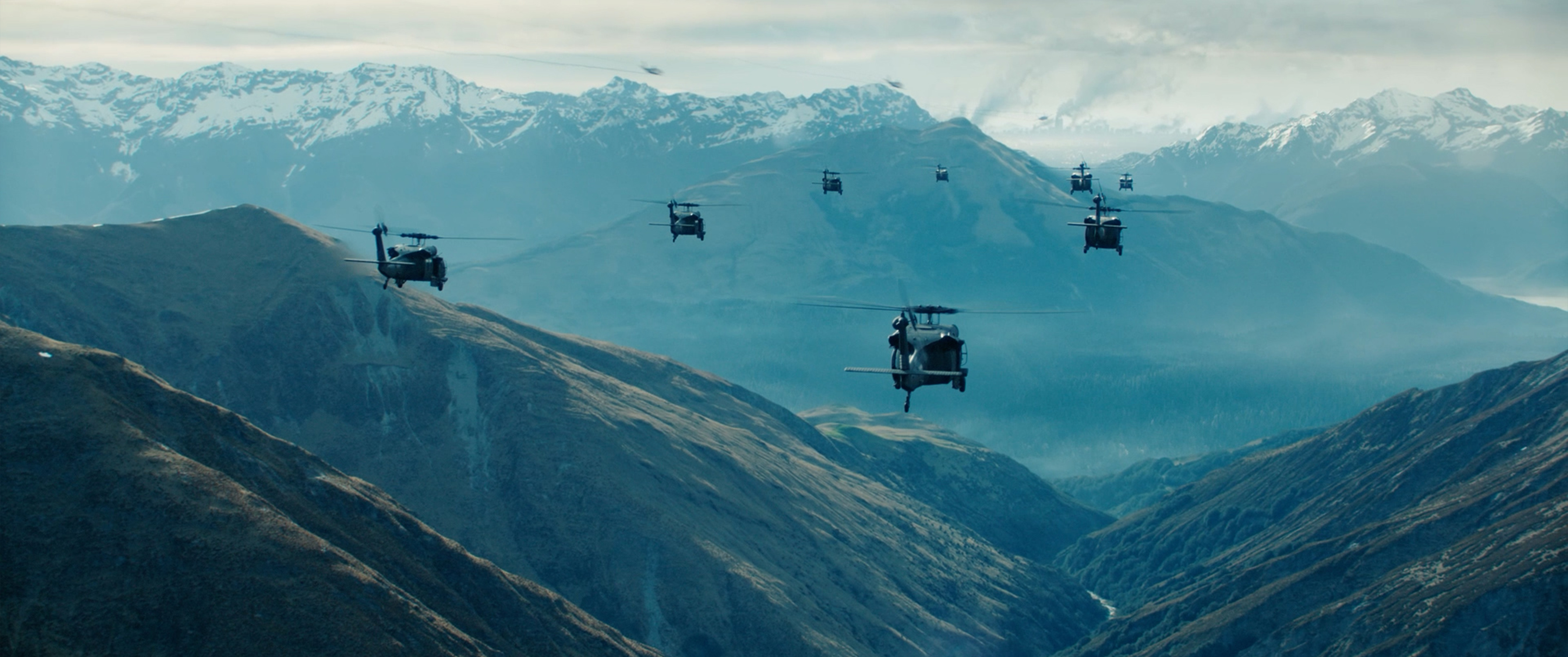
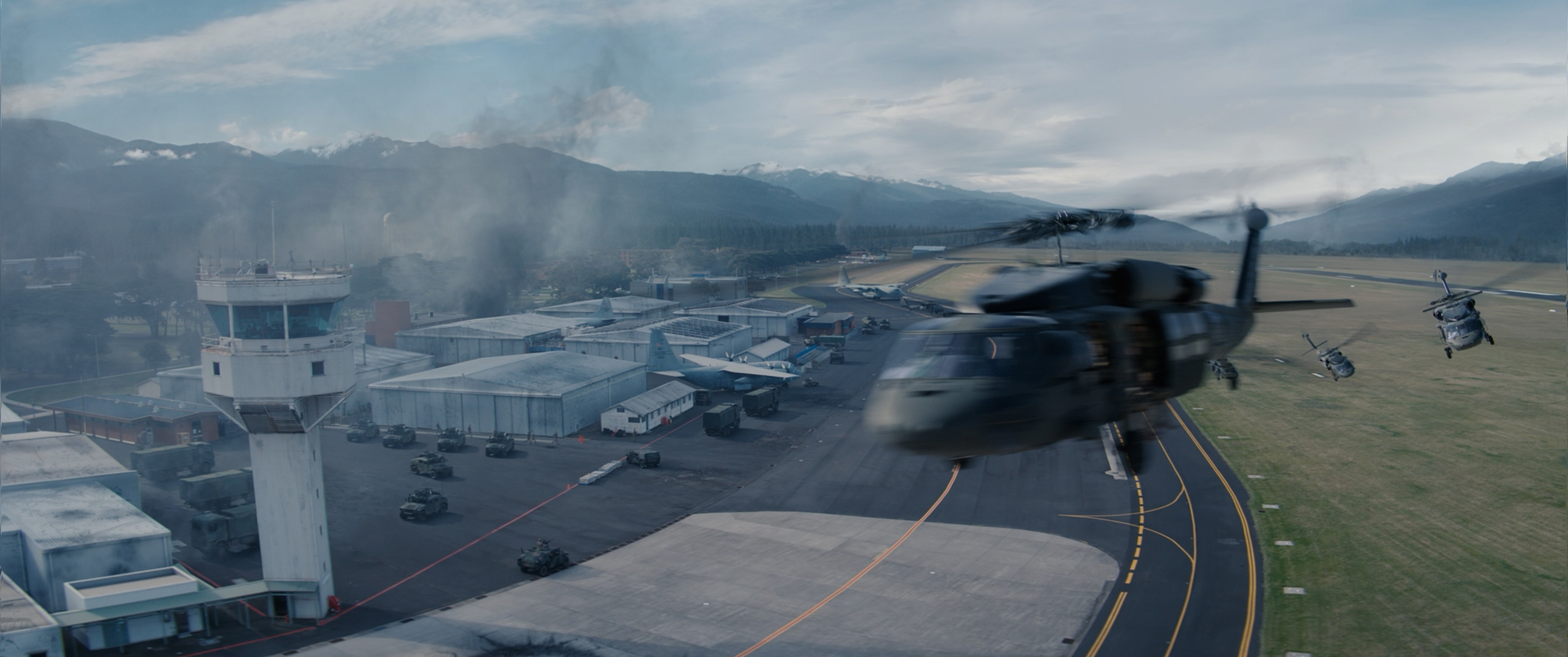
One of the most technically ambitious aspects of FIN’s work was the creation of the film’s CG Blackhawk helicopters.
Although production had access to a single practical helicopter on set, many of the sequences ultimately relied on FIN’s digital builds. The team developed the aircraft to an exceptionally high level of fidelity, with detailed modelling, shading and lighting allowing them to hold up not only in wide shots but also in mid and close-ups, where CG vehicles of this scale are rarely used.
Animation was critical to selling the realism of the aircraft.
“I’m a bit of a helicopter obsessive,” says Visual Effects Supervisor Stuart White. “So the movement of the aircraft was something I was really particular about. Helicopters have a very distinctive behaviour in the air, and the team did an incredible job capturing that weight and subtle motion in the animation.”
The attention to detail across modelling, shading and animation meant the helicopters could integrate seamlessly with the live-action photography, even in shots where the aircraft filled a large portion of the frame.
A large portion of FIN’s work focused on environment creation and digital set extensions, transforming footage shot in regional Victoria, including locations around Bright, into the mountainous landscapes of Colorado.
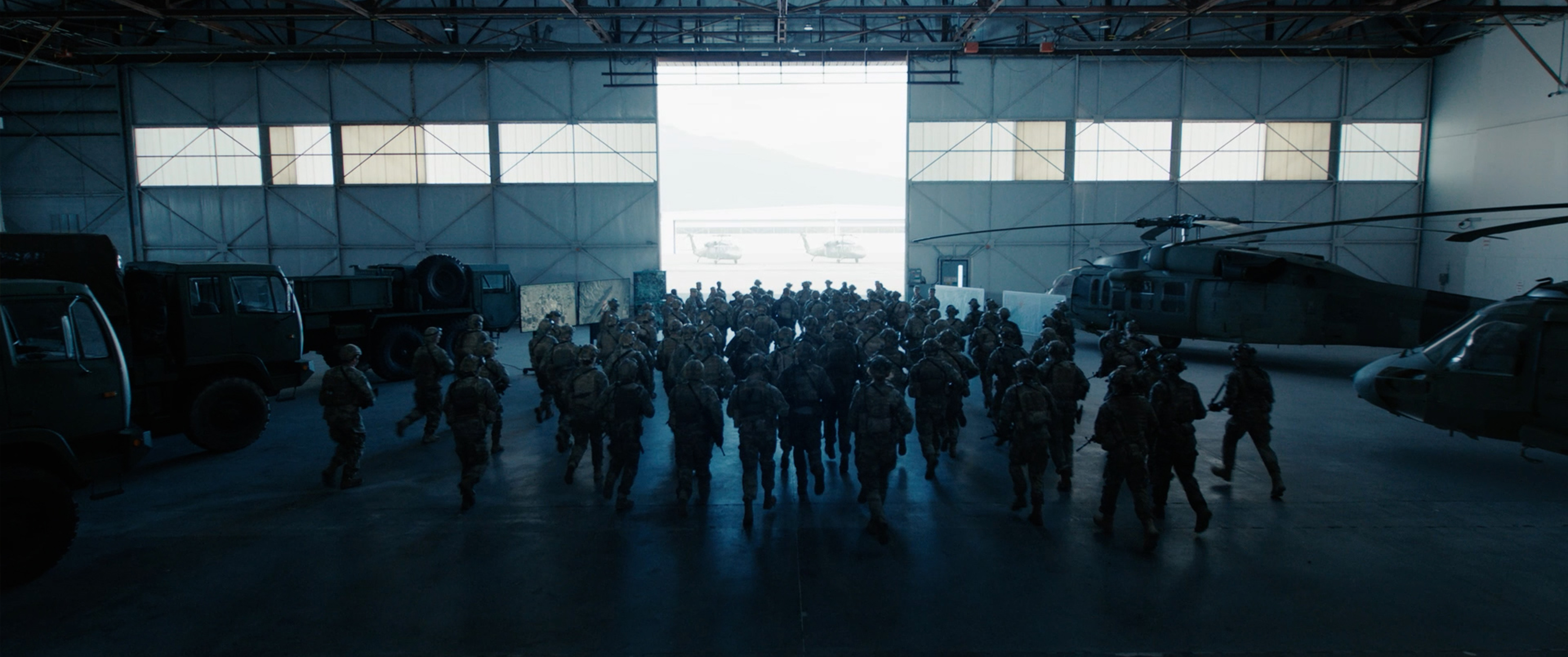
In many cases, the team expanded relatively minimal on-set elements into fully realised environments. This included building digital mountains, skies, military vehicles and multiple species of CG trees to populate forest environments and military bases.
“A lot of the plates were captured with fairly minimal environment detail, so our artists had to expand the world well beyond what was there in camera,” says White. “That meant building out landscapes, adding vegetation and vehicles, and making sure everything felt like it belonged naturally in the environment.”
Elsewhere, a rural Victorian quarry was transformed into a mass grave site in Kandahar, with large-scale terrain modification, environmental dressing and atmospheric work used to create the final setting.
Another standout sequence involved the Guardian armoured personnel carrier, which becomes trapped on top of a collapsing pile of debris.
During filming the vehicle was mounted on scaffolding and practical debris, preventing the wheels from rotating naturally. FIN rebuilt the wheels digitally so they could spin as the vehicle rolled free, while simultaneously simulating collapsing metal structures, shifting debris and heavy dust interactions as the pile gave way beneath it.
The shot required extensive rigging, simulation and compositing work to convincingly integrate the digital destruction with the practical elements captured on set.
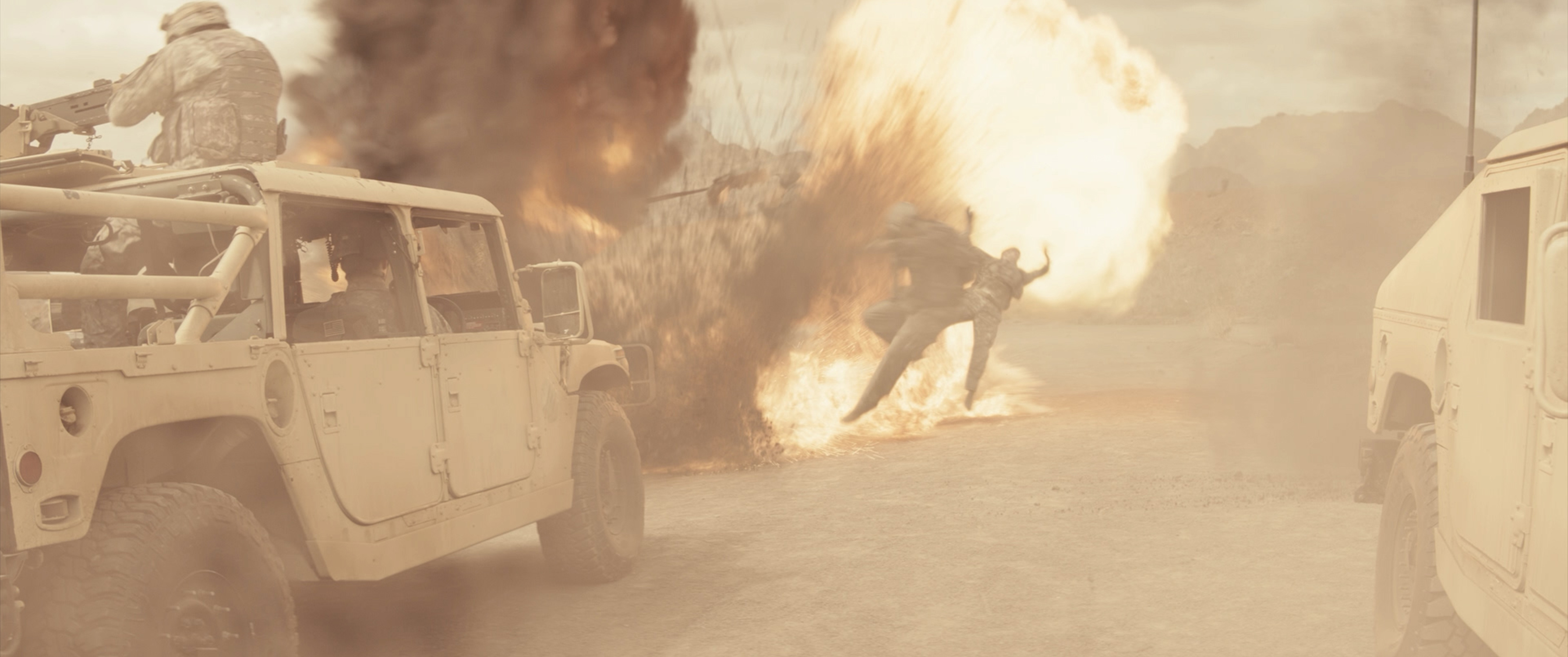
One of the most technically challenging moments in the project came in the form of a seven-camera stitch sequence, where seven separate takes were combined to create a single seamless shot.
The sequence required artists to carefully align and blend multiple camera moves into a continuous piece of action while removing visible stunt wires, harnesses and crash mats from the original photography. Practical explosions captured during filming were enhanced with additional effects work to heighten the impact of the moment.
“Those kinds of stitches can be deceptively complex,” says White. “Every camera move has to line up perfectly, and you’re also dealing with continuity across explosions, performances and lighting. Our comp team did an incredible job making it feel like one continuous moment.”
The complexity of the shot meant it became a focused effort for the compositing team, with one artist spending almost a full month dedicated solely to crafting the final stitch and ensuring the transitions between each take were completely invisible.
For White, the project highlights the strength of the artists behind the work. ‘There’s an incredible amount of craftsmanship that goes into shots like these,’ he says. ‘It’s the attention to detail from the team that really makes the work hold together on screen.’